




Ear Therapy: How Treatment Works, Its Tools, Benefits and Risks
What if a small area of the outer ear could become part of a broader approach to well-being? Auricular acupuncture stimulates selected ear points that practitioners associate with areas or functions throughout the body. French physician Paul Nogier developed research on auriculotherapy in the 1950s.
It’s natural to want clear answers before exploring a complementary practice. This guide explains what happens during a session, how practitioners use needles and ear seeds, and what potential benefits, risks, and evidence limits deserve attention. You’ll also learn how ear therapy may fit alongside other care, and why it isn’t necessarily intended to treat an ear condition. Understanding the method can help you decide whether ear therapy suits your needs and approach your next steps with informed expectations.
Table of Contents
What is Auricular Acupuncture?
Auricular acupuncture stimulates selected points on the outer ear, which practitioners associate with areas or functions throughout the body. It is used for concerns such as pain and stress, but proposed effects and supporting evidence vary.
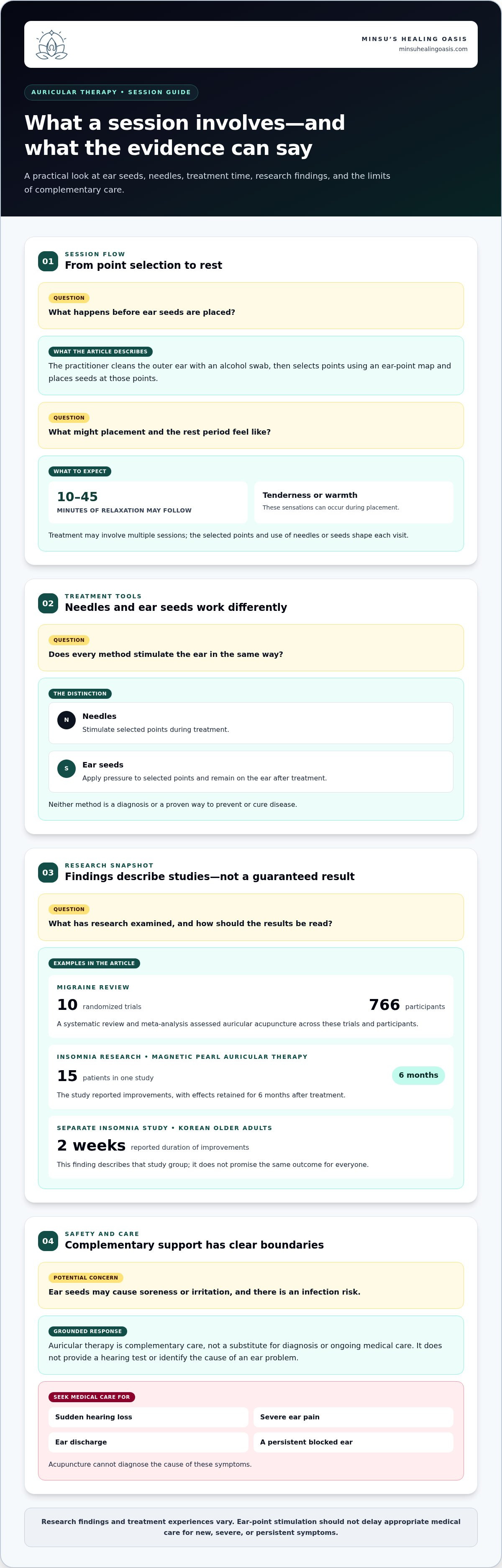
In the United States, ear therapy costs depend on the treatment format and what a session includes; insurance coverage varies by plan and billing circumstances. Seek medical care for sudden hearing loss, severe ear pain, discharge, or a persistent blocked ear, since acupuncture cannot diagnose the cause.
History of Auricular Acupuncture
Auricular acupuncture is a point-based practice with roots in French research and traditional Chinese medicine. Its history matters because today’s protocols draw on different traditions, rather than one universally used map.
Ear acupuncture was developed in France in the 19th century, and French physician Paul Nogier developed research on auriculotherapy in the 1950s. The National Acupuncture Detox Association further popularized auricular acupuncture in the 1970s. Practitioners may work with as many as 200 points, while NADA and Battlefield Acupuncture are two five-point protocols.
Pain and Nervous System Regulation
Auricular acupuncture stimulates ear points with the aim of influencing pain signals and nervous system activity. This may be relevant when chronic discomfort and stress affect daily life, but it is not a guaranteed way to relieve either.
The proposed effect is that sensory input from the ear may interact with the body’s pain-processing and regulation systems. Practitioners select points based on the person’s concern and their treatment approach. For example, ear acupuncture may complement care for headaches or back pain, rather than replace assessment of persistent or worsening symptoms.
Ear Points and Claimed Body Connections
In auriculotherapy, specific acupuncture points on the outer ear are associated with organs or areas of the body. These associations guide point selection, so treatment plans may differ depending on the concern.
Practitioners use ear maps to locate points and may select them for concerns such as anxiety, insomnia, or digestive symptoms. Some also use ear acupuncture in efforts related to weight loss or cervical vertigo. These uses don’t prove that stimulation causes weight loss or resolves vertigo; dizziness and appetite changes can have causes that need medical evaluation.
Combining Ear Acupuncture With Other Therapies
Ear acupuncture can be used on its own or as part of a broader treatment plan. Combining approaches may address different aspects of a concern, such as movement and discomfort, without treating the methods as interchangeable.
Sessions may be paired with physical therapy, chiropractic adjustment, or massage therapy. For example, someone addressing back pain might combine acupuncture with movement-focused care. The choice depends on the concern and the role of each approach. Complementary methods should support, not delay, appropriate medical care for new, severe, or persistent symptoms.
What Is Involved in the Administration of Auricular Therapy?
Auriculotherapy stimulates selected points on the outer ear using needles or ear seeds. A session may involve choosing points, placing the needles or seeds, and resting quietly afterward.
Traditional Chinese Medicine and Session Flow
Auriculotherapy is associated with traditional Chinese medicine, a practice described as extending back thousands of years. An ear-point map guides treatment by associating selected points with broader areas or functions of the body. The method may be used on its own or alongside other care.
For ear seeds, a practitioner first cleans the outer ear with an alcohol swab, then places the seeds at selected points. Tenderness or warmth can occur during placement. A relaxation period may last 10-45 minutes, and treatment can involve multiple sessions. The points chosen and the use of needles or seeds shape each visit.
Auriculotherapy is complementary, not a substitute for conventional medicine. This distinction matters when symptoms require diagnosis or ongoing medical care.
What Research Has Examined
For migraine, a systematic review and meta-analysis assessed auricular acupuncture across 10 randomized trials involving 766 participants. Those figures describe the scope of the review, not a guaranteed outcome for an individual. They also show why the specific treatment method and study results matter when interpreting claims.
Insomnia research offers examples with different follow-up periods. A study of magnetic pearl auricular therapy in elderly people reported improvements in 15 patients, with effects retained for 6 months after treatment. A separate study involving Korean older adults reported improvements lasting 2 weeks. The findings describe those study groups, not a promise that every person will sleep better.
Smoking Cessation and Detox Protocols
The National Acupuncture Detox Association popularized auricular acupuncture in the 1970s, and its NADA protocol is associated with detox-oriented use. A protocol’s name or history doesn’t establish that ear stimulation helps someone stop smoking. For smoking cessation, treat auricular therapy as complementary support, not as a replacement for established medical care or cessation treatment.
Keeping that distinction in mind helps set realistic expectations: someone seeking support for nicotine use should consider a broader cessation plan rather than rely on ear points alone. Ear seeds apply pressure after placement, while needles stimulate points during treatment.
How It Compares With Audiology or ENT Care
Auricular therapy stimulates points; it doesn’t provide a hearing test or diagnose an ear condition. Audiologists assess hearing, while ear, nose, and throat physicians evaluate medical concerns such as hearing changes or blocked ears. Seek clinical assessment for those concerns, and consider acupuncture complementary rather than a substitute.
Needles, semi-permanent needles, and ear seeds
Ear-point stimulation may use single-use needles, semi-permanent needles, or adhesive ear seeds. Earwax removal and sound therapy are different approaches: one addresses wax buildup, while the other uses sound rather than pressure on ear points.
The tool affects how stimulation is delivered and how long it continues. For example, needles may be used briefly during a session, while seeds remain on the outer ear afterward.
What Ear Seeds Are Made Of
Ear seeds are small adhesive pieces that hold a seed or pellet against an acupuncture point. The material presses on the skin, while the adhesive keeps the seed in place.
Seeds may contain Vaccaria, including a ripe Vaccaria seed, or a small gold or stainless steel pellet; some versions use metal or ceramic. The adhesive pieces are about 5 to 7 millimeters across and sit on the outer ear, not inside the ear canal. A practitioner selects placement according to the chosen points, then secures each seed with adhesive tape.
How Ear Seeds Work and How Long They Stay On
Ear seeds are intended to stimulate selected points with steady pressure, extending stimulation beyond the treatment session. This may appeal to someone seeking ongoing pressure without needles remaining in place.
They should be removed after three to five days. According to the Cleveland Clinic, gently massaging the seeds three to five times per day can apply additional pressure. Follow the placement and removal guidance given for your treatment; don’t push a loose seed toward the ear canal. If adhesive wears out, a seed can fall into the canal and may require medical help for removal.
Seeds or tacks may be left on the ear for up to a week, while another description gives a range of 3 to 14 days. These durations differ, so the type of material and the practitioner’s specific instructions matter. For a clear care plan, ask how long the selected seed should remain in place.
Ear Seeds Compared With Needles
Ear seeds apply pressure without piercing the skin, while acupuncture needles stimulate points through insertion. Semi-permanent needles stay in place longer than the thin, single-use needles used during a session, so each option delivers stimulation differently.
Needles used for auricular therapy may be as much as 10 times smaller in diameter than average injection needles used in a doctor’s office. Practitioners typically use sterile, single-use needles. Seeds suit ongoing acupressure between sessions; needles deliver stimulation during treatment. The choice depends on the intended method, placement, and comfort, including whether pain management is part of a broader care plan. Auricular methods complement medical care, rather than replace it.
Potential side effects and infection risk
Most reactions described with auricular acupuncture involve the placement site or the body’s response during treatment. Knowing the difference between temporary soreness and a concern that needs medical attention can help you make an informed choice.
Possible Effects During or After Treatment
Reported effects include soreness, dizziness, bleeding, nausea, headache, and irritation where a needle enters the skin. Bruising or minor bleeding can occur at the insertion site. For example, a tender spot after needle placement differs from discomfort that persists or interferes with daily activities.
These reactions may matter whether treatment is intended to support anxiety care or chronic pain management. An ear seed also applies pressure to a small area, and massaging around it can add pressure. Tell the practitioner if you feel discomfort during a session, especially if it is sharp or intensifies.
Infection and Ear Seed Risks
Infection is a risk of auriculotherapy, particularly with a semi-permanent needle left in place longer. Infection at a semi-permanent needle site is described as very rare, but skin irritation or a worsening reaction deserves attention. Sterile, single-use needles reduce concerns related to reuse, but don’t eliminate every risk of piercing the skin.
An ear seed can fall into the ear canal if its adhesive wears out, sometimes requiring medical help for removal. Don’t push a loose seed inward. If it seems lodged in the canal, seek medical assistance rather than trying to remove it with a pointed object.
Precautions Before Treatment
Before starting acupuncture, discuss your health conditions and medications with a doctor familiar with your circumstances. This is especially relevant if a condition affects bleeding, healing, or skin sensitivity. Tell the practitioner about past reactions to adhesives or metal, too.
Pregnant people should avoid ear seeds unless the treatment is specifically intended to stimulate labor. The purpose of stimulation changes the risk discussion. Older adults may need additional care during auricular therapy, including attention to skin sensitivity and comfort while points are selected.
After placement, notice whether symptoms stay local or affect your wider well-being. Mild soreness differs from persistent pain, increasing irritation, or dizziness that disrupts everyday activities. Contact a healthcare professional about concerning symptoms and discuss whether continuing treatment is appropriate. People can respond differently, so communicating clearly during a session helps the practitioner address discomfort rather than simply continue stimulation.
Potential benefits and limitations of the evidence
Auricular acupuncture has been studied as a way to ease selected symptoms, including pain and migraine. The evidence raises promising questions, not a universal answer: results depend on the condition, treatment method, and study design. This distinction helps patients weigh possible relief alongside side effects and standard care.
For pediatric migraine, a pilot study in an emergency department reported lower pain scores within 15 minutes. A pilot study can help identify a direction for further research, but its result doesn’t establish the same effect for every child or setting. The measured outcome was pain scores, not a cure for migraine or prevention of future attacks.
An adult randomized open-label study evaluated auriculotherapy over three monthly sessions. Its design offers a structured way to examine treatment, while the open-label format means participants knew which treatment they received. This matters when interpreting self-reported symptoms, since expectations can influence how patients describe changes in pain or well-being.
Research has also explored auriculotherapy for gastrointestinal symptoms, chemotherapy-related pain, numbness and tingling, lower back pain, depression, and grief. These concerns don’t share a single outcome measure. For example, a change in reported pain differs from a change in digestive symptoms, so evidence for one use shouldn’t automatically be applied to another.
Researchers may use ear maps that associate acupuncture points with particular body areas or functions. This traditional framework can guide treatment, but a proposed association isn’t proof of a clinical effect. Auriculotherapy isn’t fully scientifically proven, and research specifically on ear seeds remains very limited. Ear seeds haven’t been proven to prevent or cure disease.
When reviewing a claim, note the condition studied, the treatment used, the outcome measured, and the comparison group. A study of needles, for instance, doesn’t automatically establish the effects of seeds or acupressure. Consider whether the finding concerns short-term relief, lasting change, or side effects. These distinctions help you discuss complementary care without replacing diagnosis or treatment for an underlying condition.
For a grounded decision, connect the research to your own care plan: identify the symptom you hope to address, track changes, and keep conventional medical care in view. If you’re exploring auricular acupuncture as part of your support, Minsu’s Healing Oasis offers auriculotherapy alongside physical and manual therapies.
Minsu’s Healing Oasis: Physiotherapy and Manual Therapy
Minsu’s Healing Oasis offers physical and manual therapies for people seeking support with movement, physical discomfort, or recovery. After learning about auricular acupuncture, you may be considering how other approaches could fit into your broader well-being. Manual therapy and myofascial release offer hands-on care, while Energy Healing and Alternative Therapies and Quantum Healing Technique provide additional options.
These services don’t replace medical assessment when symptoms need diagnosis or urgent attention. They may be relevant when you’re exploring supportive care alongside an appropriate health plan and want to understand which approach suits your needs.
For a gentle next step, contact Minsu’s Healing Oasis to learn more about its offerings.
Choose a Supportive Next Step
Your next step can depend on the support you’re seeking. If your focus is movement or physical discomfort, physical and manual therapies offer a different path from ear-based stimulation. Myofascial release is another hands-on option, while Energy Healing and Alternative Therapies may suit a more holistic interest. Each approach has its own role, so consider what you hope to address and how it fits alongside your wider care.
Exploring ear therapy doesn’t require setting aside conventional medical care or deciding everything at once. Begin with a thoughtful conversation about your needs and the approaches that feel appropriate. Minsu’s Healing Oasis offers these therapy options as part of its broader well-being services.
If you’d like to explore a supportive next step, contact Minsu’s Healing Oasis. Let your path forward begin with care, clarity, and a choice that feels right for you.
Frequently Asked Questions
Is auriculotherapy scientifically proven?
Auriculotherapy isn’t fully scientifically proven, and the evidence varies by condition and method. Some studies examine specific outcomes, such as migraine pain or sleep, but their findings don’t establish that every patient will experience relief. Research on ear seeds is especially limited. Treat the results as an area of ongoing investigation, not proof of a cure, and keep evidence-based medical care in your plan.
What Are Ear Seeds and What Do They Do?
Ear seeds are small pieces attached to selected points on the outer ear to apply pressure. They may use a Vaccaria seed or a small metal or ceramic pellet. People sometimes press or massage them to stimulate the point between sessions. If a seed loosens, don’t push it toward the ear canal; seek medical help if it becomes lodged there.
What is auriculotherapy and does it work?
Auriculotherapy is a complementary practice that stimulates selected points on the outer ear. Whether it helps depends on the symptom studied, the method used, and the outcome measured. For instance, evidence about needle-based treatment shouldn’t automatically be applied to ear seeds. It may be considered alongside conventional care, but ear stimulation shouldn’t replace diagnosis or treatment for an underlying health problem.
Who performs auriculotherapy?
Auriculotherapy may be performed by practitioners trained in acupuncture techniques; a licensed acupuncturist can help place ear seeds at points suited to a person’s needs. The tool matters: inserting a needle differs from applying non-invasive pressure with a seed. Before treatment, discuss relevant health conditions with a doctor familiar with your care, especially if you’re considering acupuncture for an ongoing symptom.
What are the benefits and evidence for different ear therapy treatments?
Studies have explored auricular acupuncture for concerns including migraine, insomnia, and pain, but the evidence doesn’t establish equal benefits across treatments. A finding involving needles may not apply to seeds, and a reported change in pain doesn’t prove an effect on sleep or another symptom. Compare the method, condition, and outcome before drawing conclusions, and view these approaches as complementary rather than cures for disease.
What are the risks and side effects?
Possible effects include soreness, minor bleeding, bruising, dizziness, nausea, headache, or skin irritation. Infection is also possible, particularly when a needle remains in place. Adhesive on an ear seed can loosen, allowing the seed to fall into the ear canal. Tell your practitioner about discomfort, and discuss your health conditions with a doctor before beginning acupuncture or auriculotherapy.
How do I find a licensed ear therapist or qualified provider near me?
Look for a practitioner whose training covers the specific method you’re considering, such as needle placement or ear-seed use. A licensed acupuncturist can help place seeds at points suited to your needs. You can also consult your state’s licensing board to review a practitioner’s license status. If you have a medical condition or persistent symptoms, include your doctor in the decision.
What happens during an ear therapy appointment?
An appointment typically begins with a discussion of your symptoms and treatment goals, followed by selection of an approach and ear points. The practitioner may clean the outer ear before placing seeds or use needles during the session. You may rest quietly afterward. Share relevant health information beforehand, and speak up if you feel discomfort or become dizzy during treatment.



Comments