




Ancestral Cord Healing: Releasing Generational Burdens and Reclaiming Your Vitality
Updated: 22 hours ago
What if the shame, fear, or persistent tension you carry isn’t entirely yours to hold? When familiar struggles seem to echo through your family story, it’s natural to look beyond surface-level symptoms for understanding. Ancestral cord healing offers a spiritual framework for exploring inherited emotional patterns and gently releasing what no longer supports your well-being, without severing the love or wisdom of your lineage.
Family history can shape how you feel and respond, even when the connection isn’t obvious. That doesn’t mean every challenge comes from an ancestor, or that energetic cords are scientifically established. It does mean your experience deserves care, curiosity, and a whole-person perspective that honors both body and spirit.
In this article, you’ll learn how ancestral cords are understood, how generational patterns may show up emotionally and physically, and what a gentle release process can involve. You’ll also find practical ways to reflect on family patterns, distinguish them from your own choices, and move forward with greater clarity while staying connected to the wisdom of your roots.
Table of Contents
What Is Ancestral Cord Healing and How Does It Form?
Ancestral cord healing is a spiritual practice centered on recognizing and releasing inherited energetic attachments and emotional patterns. In this framework, cords are understood as invisible pathways connecting a person to unresolved grief, fear, or limiting beliefs carried through a family line. They aren’t physical structures, and the idea of an energetic cord is not a scientifically established mechanism. The concept can still offer a meaningful lens for exploring why some burdens seem to reach beyond your personal experiences.
Family patterns can also be explored through everyday dynamics: what was modeled, what went unspoken, and which ways of coping were passed along. A child raised amid scarcity, for example, might learn to expect instability even when their circumstances later change. Ancestral cord healing invites you to consider these influences without deciding in advance that a feeling has a spiritual cause.
The Anatomy of Energetic Attachments
Within energy-healing traditions, cords symbolize subtle relational bonds shaped by generations of shared emotional experience. Practitioners may describe them in relation to chakras, or energy centers. The root chakra is associated with safety and belonging, while the solar plexus is linked with agency and self-worth. Survival fears, guilt, and emotional conditioning may be pictured as frequencies moving through a family line. These are spiritual interpretations, not physical pathways that can be measured.
Respect for ancestors takes many forms across cultures, from remembrance to ritual. The overview of Ancestor Worship and Veneration offers broader context for these traditions. In healing work, honoring lineage can mean acknowledging what previous generations endured while choosing not to repeat every response they needed to survive.
Recognizing Signs of Inherited Emotional Weight
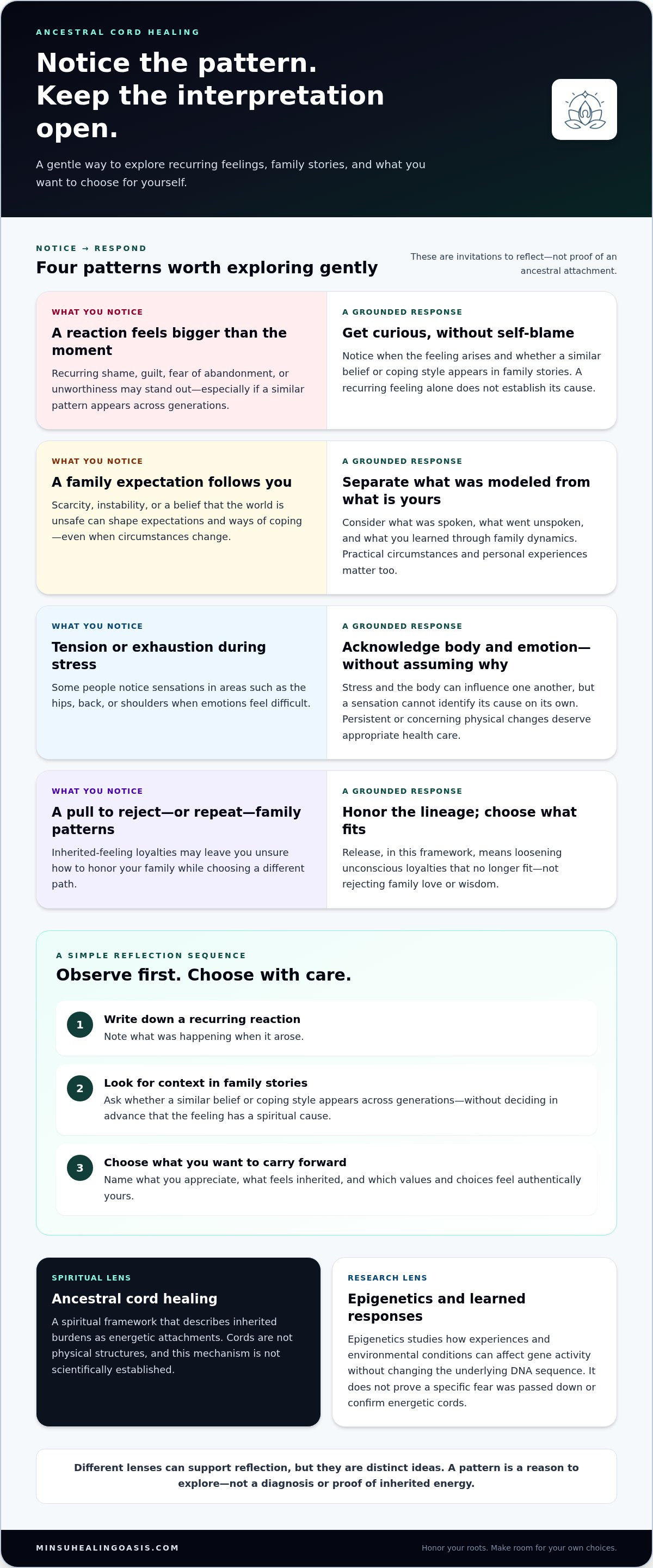
Does a reaction feel larger than the moment that triggered it? Recurring shame, guilt, fear of abandonment, or a persistent sense of unworthiness may invite gentle inquiry, especially when a similar pattern appears across generations. Financial scarcity can also become a family expectation, although practical circumstances and personal experiences matter too. None of these signs proves an ancestral attachment. They are invitations to notice, reflect, and seek understanding without self-blame.
Some people also notice exhaustion or tension in areas such as the hips, back, or shoulders during periods of emotional stress. A whole-person approach can acknowledge that the body and emotions influence one another without claiming inherited energy caused a physical symptom. Persistent or concerning physical changes deserve appropriate health care alongside any spiritual exploration.
Start by observing rather than trying to force a release. Write down a recurring reaction, what was happening when it arose, and whether a similar belief or coping style appears in family stories. Ask yourself what you appreciate, what feels inherited, and what you want to choose for yourself. In this approach, release doesn’t mean rejecting your family. It means honoring your lineage while loosening unconscious loyalties that no longer fit your life, making room for your own values and choices.
The Science and Spirit Behind Generational Patterns
Can family history influence how you respond to stress today? Psychology offers one way to explore that question, while spiritual traditions offer another. Research into epigenetics examines how experiences and environmental conditions can affect gene activity without changing the underlying DNA sequence. Researchers continue to study how these effects may relate to later generations. The findings don’t prove that a specific fear or physical sensation was passed down through a family line, or confirm the existence of energetic cords.
Understanding Intergenerational Trauma also involves looking beyond biology. Children may absorb family coping strategies, expectations, and ways of expressing emotion through relationships and shared environments. Someone who grew up hearing that the world is unsafe, for instance, may become highly alert to possible threats, even in circumstances that differ from those their relatives faced.
Epigenetics and Cellular Memory
“Cellular memory” and “somatic tissue memory” are often used in holistic settings to describe how stress seems to live in the body. These can be meaningful metaphors, but they aren’t established proof that a particular ancestor’s experience is stored in your tissues. Stress can affect the body’s responses, including patterns of alertness and tension, but a sensation in your shoulders or stomach can’t identify its cause on its own.
This distinction lets clinical ideas and energy work sit alongside one another without being confused. Ancestral cord healing may frame inherited burdens as energetic attachments. A psychological perspective may explore learned responses, family narratives, and the body’s stress reactions. Each offers a different lens, and neither should be used to diagnose the other.
The Spiritual Field of Family Systems
In family constellation approaches, practitioners may explore how loyalty, grief, or a sense of responsibility shapes someone’s place in a family system, including feelings connected to relatives who have died. These experiences are interpreted within a therapeutic or spiritual framework, not as proof of a literal field carrying information. Biological inheritance, learned behavior, and spiritual understanding are distinct ideas, even when they help a person reflect on similar questions.
This reflection can make room for a more compassionate story. Perhaps a relative’s vigilance once helped them cope, but you don’t need to carry the same response into every part of your life. The aim isn’t to blame ancestors or deny hardship. It’s to recognize what helped a family endure, then decide what still serves you. Integrative approaches can pair energetic clearing with body-focused care. The Quantum Healing Technique is one energy modality offered for exploration, not a scientifically proven method of cellular renewal.
If this whole-person perspective resonates, explore ancestral cord healing at Minsu’s Healing Oasis as one way to reflect on generational patterns with care. Spiritual practice can complement personal reflection, but it shouldn’t replace medical or mental health support when you need it.
Releasing Burdens vs. Cutting Love: Navigating the Core Dilemma
Does letting go of an inherited burden mean turning away from your family? In ancestral cord healing, release is not meant to sever love, erase history, or reject the people who came before you. It is a symbolic process of loosening patterns that feel constricting while keeping the care, values, and wisdom you want to carry forward.
This distinction matters when healing brings up guilt or fear of disloyalty. You can feel gratitude for a relative’s sacrifices without repeating their suffering, and you can maintain meaningful family ties while choosing different boundaries or beliefs. Energetic cords are a spiritual framework, not a measurable explanation for family dynamics. The important thing is to explore the idea in a way that supports reflection rather than blame or fear.
Distinguishing Depleting Patterns from Loving Bonds
Within energy-healing traditions, a depleting cord may represent an attachment associated with shame, unresolved grief, codependency, or a recurring sense that you must suffer to belong. A loving bond, by contrast, may symbolize nourishment, grounding, protection, and connection to family wisdom. These are interpretive distinctions, not objective diagnoses of relationships or energies.
To explore what an attachment means to you, notice its effects. Does remembering this family connection bring warmth and steadiness, or pressure and self-abandonment? Consider the specific belief or behavior involved, too. A relative’s resilience may be worth honoring, while a learned expectation to stay silent may no longer serve you. One connection can hold both tenderness and pain.
The Philosophy of Compassionate Detachment
Compassionate detachment means recognizing hardship without making it your duty to recreate it. If your family endured scarcity, for example, you can respect the resourcefulness that helped them survive while questioning whether constant fear about the future belongs in every decision you make. Healing beyond an ancestor’s limitations isn’t a betrayal. It’s a choice to let care, rather than inherited guilt, guide your next steps.
A brief reflection can help keep the process grounded. Write two lists: what you wish to honor from your lineage, and what you’re ready to approach differently. You might name generosity, courage, or cultural traditions on one side, and silence, shame, or self-neglect on the other. Treat the exercise as exploration, not proof that a spiritual attachment exists or needs to be cut.
In this approach, “clearing” means intending to release fear-based interpretations or loyalties that restrict your choices. It isn’t a promise to remove distress or change another person. The aim is to preserve supportive connections and make room for boundaries where they’re needed. You can carry forward love without carrying every burden. Your family story can remain part of you without defining the whole of who you are.
How a Professional Ancestral Healing Session Unfolds
Ancestral cord healing is a reflective energy practice, not a medical procedure or a scientifically established way to detect physical cords. A practitioner may guide you through intention-setting, grounding, visualization, and integration, adapting the process to your comfort. You can ask questions, pause, or choose not to continue at any point.
Preparation and Setting Sacred Intention
A session begins with conversation. You might share a recurring relationship pattern, a family story that stays with you, or areas where you notice tension or stress. You don’t need a complete family history or a dramatic revelation. A simple intention, such as “I want to understand this pattern with compassion,” can offer a steady focus without deciding in advance what caused it.
The practitioner may then invite you to settle into the present through slow breathing or another gentle grounding practice. The purpose is to create a calm, respectful space for reflection, not to force a particular emotional response. If focusing on family experiences feels overwhelming, say so. The pace can remain supportive and within your boundaries.
The Clearing and Extraction Process
Practices differ, and no single ritual guarantees release. The focus is on approaching family patterns thoughtfully, rather than reliving painful events or accepting an explanation that doesn’t feel right. Restorative therapies can sit alongside energy work as part of a whole-person approach. Red light therapy is another modality offered at Minsu’s Healing Oasis, but it should not be presented as a proven way to clear ancestral attachments or soothe the nervous system.
Post-Session Integration and Energetic Care
There’s no universal response or set timeline, including during the first 48 hours. You may feel reflective, emotional, settled, or simply unchanged. Give yourself space to notice without treating any reaction as proof that a cord was present or successfully removed. Drink water if you’re thirsty, eat as you normally would, and choose quiet, familiar activities if they feel supportive.
Integration can also mean practicing clear boundaries with living relatives. You might pause before agreeing to an old family role, or choose a calm response when familiar guilt arises. These small choices turn reflection into action. If distress persists or physical symptoms concern you, seek appropriate health support. Energy work isn’t a substitute for medical or mental health care.
To explore this gentle, intention-led process, book an ancestral cord healing session with Minsu’s Healing Oasis.
Restoring Wholeness: Reclaiming Your Sovereign Path
What might change if family history could inform your life without directing every choice? In a spiritual framework, releasing ancestral burdens can create a sense of spaciousness in your heart and body. It isn’t a promise that tension or emotional distress will disappear. Reflection may instead help you recognize old patterns and decide which beliefs, responses, and values you want to carry forward.
Sovereignty means having room to choose, not rejecting your lineage or pretending the past had no effect. You might notice guilt arise when setting a boundary, then pause to ask whether the reaction reflects your present values or an expectation you learned. That moment of awareness can support a response that feels more considered and true to you.
Cultivating Daily Energetic Boundaries
A simple morning routine can help you feel centered before the day begins. Sit comfortably, notice your feet on the floor, and take a few unhurried breaths. Name one quality you want to embody, such as patience, courage, or steadiness. In energy-healing language, this anchors your attention. Practically, it creates a moment to check in with yourself before responding to other people’s needs.
When an old guilt trigger appears, pause briefly: notice what happened, name the feeling, and choose your next step rather than reacting automatically. You might use an affirmation such as, “I can honor my family and make choices that support my life.” Let the words feel sincere. They’re a personal reminder, not a guarantee of an energetic change.
Integrating Energy Work with Whole-Body Restoration
Energy practices can be part of a broader approach to well-being, alongside gentle movement, intentional rest, and appropriate physical care. Manual therapies may support physical restoration, while energetic clearing offers a space to reflect on emotional and family patterns. These approaches have different purposes, and neither should be presented as proof of a spiritual breakthrough or a substitute for medical care. Pay attention to what feels supportive, and let your needs guide the pace.
Keep post-session integration manageable. You could take a short walk, stretch within your comfort, or jot down one choice that reflects your values. If family interactions bring up familiar pressure, a boundary might be as simple as taking time before answering a request. These everyday actions make sovereignty practical: you can stay connected to loved ones while deciding how you participate.
Ancestral cord healing may be one part of a continuing whole-person practice, not a single event that determines your future. To explore this work as part of your restorative path, schedule an energy healing session with Minsu’s Healing Oasis.
Choose a More Spacious Way Forward
Your next step doesn’t need to be dramatic. Notice one inherited expectation you’re ready to question, then choose a response that feels more aligned with the life you want to create. Small, steady choices can honor your roots while making room for your own direction.
Ancestral cord healing can be one part of that exploration. At Minsu’s Healing Oasis, an integrative approach brings physical manual therapy together with energy work, holding space for body, mind, and spirit. Ancestral Cord Healing offers a way to reflect on lineage and family patterns without dismissing your lived experience or rushing the process.
If you feel ready to explore this path with care, Begin your journey to generational freedom and vibrant wholeness with Minsu’s Healing Oasis. Move forward with curiosity, self-respect, and growing trust in the choices that are truly yours.
Frequently Asked Questions
What exactly is ancestral cord healing and how does it work?
Ancestral cord healing is an energy-healing practice that uses reflection and symbolic techniques to explore patterns a person associates with family history. A session may include discussing an intention, guided imagery, or quiet attention to emotional themes. For example, you might reflect on a fear that arises around success and consider what family messages shaped your beliefs. Cords are understood spiritually, not as physical structures.
Can cutting ancestral cords damage my relationship with living family members?
The practice is generally intended as an inward process, not a way to end contact or change another person. You can release an old sense of obligation while still choosing closeness, conversation, or care with relatives. For example, you might stop taking responsibility for a sibling’s decisions while continuing to enjoy time together. Practical boundaries in a relationship are separate choices based on your circumstances.
How do I know if the emotional patterns I experience are ancestral?
You can’t reliably identify a feeling as ancestral based on intensity or repetition alone. Track when it appears, what tends to trigger it, and whether similar beliefs or coping styles are part of your family story. Compare that with your own experiences and current stressors. Journaling can reveal useful themes, but it can’t prove an energetic cause or replace support for ongoing distress.
What does an ancestral cord healing session feel like physically and emotionally?
Experiences vary. You might feel relaxed, thoughtful, emotional, physically unchanged, or a mix of responses. No particular sensation confirms that a cord has been found or released. Tell the practitioner if you feel uncomfortable, need a pause, or would rather skip an exercise. Afterward, give yourself time to reflect without judging the session by whether you felt a dramatic shift.
Is ancestral cord healing supported by any scientific or psychological concepts?
Some related ideas have scientific or psychological context, but that doesn’t establish energetic cords as real or measurable. Research into epigenetics examines how environmental influences can affect gene activity, while psychology considers how family relationships, learned behaviors, and trauma may shape later generations. These fields can inform reflection on inherited patterns, but they don’t verify that a specific sensation or belief came from an ancestor.
How many sessions are typically needed to release deep generational burdens?
There isn’t a standard number of sessions, and no set course can guarantee that a burden will be released. Needs and preferences differ: one person may want a single reflective experience, while another may prefer ongoing support as they work through different themes. Consider your goals, how you feel after each session, and whether the approach remains helpful. You can pause or reconsider at any point.
What steps should I take to prepare for an energetic cord healing session?
Before your session, write down one or two themes you’d like to explore, such as a recurring family role or a belief that affects your choices. You don’t need a complete family history. Note any questions, sensitivities, or practices you’d prefer to avoid, and bring them up at the start. Arrive with an open mind, while remembering you can decline an interpretation that doesn’t feel right to you.



Comments